What We Treat › Athletic Recovery
Physician-Directed Care · Scottsdale AZ

Train Hard.
Recover Faster.

Your performance is only as good as your recovery. Elite athletes have known this for years. IV therapy for athletic recovery isn't a gimmick — it's the fastest way to replace what intense training destroys: fluids, electrolytes, amino acids, and the cellular energy substrates that drive muscle repair and adaptation.

2–3xFaster rehydration vs. oral intake
24 hrsEarlier return to training for many patients
100%Bioavailability of every nutrient delivered
Are you experiencing any of these?
  • Sore muscles lasting 3+ days after training
  • Persistent fatigue despite rest days
  • Performance plateau despite consistent training
  • Cramping during or after workouts
  • Poor sleep quality after intense training
  • Slow recovery from competition
  • Overtraining syndrome symptoms
Dehydration Electrolyte Loss Muscle Damage Oxidative Stress
🏥 Physician Consult Required
Triamcinolone Injection
$150

A long-acting corticosteroid that delivers powerful, targeted relief for joint pain, arthritis, bursitis, tendinitis, and autoimmune inflammation — with effects that can last weeks to months from a single injection.

  • Powerful anti-inflammatory for joints, tendons, and bursae
  • Treats arthritis, bursitis, and tendinitis
  • Long-lasting relief — effects persist weeks to months
  • Physician consultation required prior to administration
View Injections Menu →

Recovery Isn't Optional

Intense exercise is controlled cellular damage. Your body's adaptation to training depends entirely on what happens in the recovery window — and most athletes are severely under-resourced in that window.

🏃
Prolonged muscle soreness (DOMS)Delayed onset muscle soreness lasting more than 48–72 hours indicates incomplete recovery — driven by muscle fiber micro-tears, inflammation, and electrolyte depletion that oral nutrition can't fully address.
Performance plateauWhen training volume and intensity stay high but performance stagnates, it's almost always a recovery deficit. Your body can't adapt to a stimulus it hasn't recovered from.
💧
Persistent thirst after hydrationExercise in Scottsdale's heat can produce sweat losses of 1–3 liters per hour. Oral rehydration replaces fluid but not electrolytes at the right ratio — leaving cells functionally dehydrated even after you've "drunk enough."
🦵
Cramping during or after exerciseElectrolyte depletion — particularly magnesium and potassium — is the primary cause of exercise-induced cramping. Sports drinks replace sodium but often miss the magnesium that muscle function requires.
😴
Poor sleep despite exhaustionOvertraining elevates cortisol and disrupts the HPA axis, paradoxically making sleep harder despite physical exhaustion. Magnesium IV has documented calming effects on the nervous system that support recovery sleep quality.
🧠
Mental fatigue alongside physicalOvertraining isn't just physical. Central nervous system fatigue — characterized by poor motivation, difficulty concentrating, and cognitive slowing — is a real and measurable consequence of inadequate recovery.
🤒
Frequent illnessHeavy training temporarily suppresses immune function — the "open window" of immunosuppression post-exercise. Vitamin C and zinc IV support immune function during this vulnerable recovery window.
📉
Loss of training motivationPersistent low motivation for training you used to love is a classic overtraining warning sign. It's your central nervous system signaling that the recovery debt has grown too large.

What Exercise Actually Depletes

Recovery isn't passive. It requires specific biological resources — and intense training depletes them faster than most nutrition plans can replace.

01
Fluid & Electrolyte Depletion
In Scottsdale's climate, a single hour of intense outdoor exercise can produce 1–2 liters of sweat loss. Electrolytes lost in sweat include sodium, potassium, magnesium, calcium, and chloride — each critical for muscle contraction, nerve signaling, and cellular hydration. Oral sports drinks replace sodium and some potassium but typically miss magnesium entirely. IV electrolyte replenishment delivers the complete profile at 100% bioavailability, restoring cellular hydration where oral drinks cannot reach.
02
Exercise-Induced Oxidative Stress
Intense exercise dramatically increases oxygen consumption — and with it, free radical production. These reactive oxygen species (ROS) damage muscle fibers, mitochondria, and cell membranes if not neutralized by antioxidants. Exercise depletes glutathione and vitamin C faster than the body can synthesize them. IV glutathione and vitamin C replenishment immediately restores antioxidant capacity, reducing the duration and severity of post-exercise inflammation and muscle damage.
03
Amino Acid & Protein Substrate Depletion
Muscle repair requires a specific array of amino acids — particularly the BCAAs (leucine, isoleucine, valine) and conditional essentials like glutamine and arginine. During intense exercise, muscle protein breakdown accelerates. The post-exercise window is when delivering these amino acids directly to muscle tissue via IV produces maximum benefit — bypassing the digestive lag that oral protein shakes experience and delivering substrates exactly when repair processes are most active.
04
B Vitamin Depletion
B vitamins — particularly B1, B2, B6, and B12 — are cofactors in every major energy production pathway: glycolysis, the Krebs cycle, and oxidative phosphorylation. High-volume training dramatically increases demand for these vitamins. Deficiency impairs energy metabolism, increases perceived exertion, and slows recovery. IV B-Complex delivers the full spectrum immediately after training when cellular uptake is highest.
05
NAD+ Cellular Energy Decline
NAD+ is the coenzyme that powers mitochondrial ATP synthesis — the cellular energy currency your muscles run on. Intense exercise depletes NAD+ significantly, and the rate of NAD+ regeneration is a limiting factor in how quickly muscle cells can restore their energy output. For high-frequency training athletes, regular NAD+ IV therapy helps maintain baseline cellular energy capacity and supports the mitochondrial biogenesis that drives long-term endurance adaptation.
06
Inflammation & Tissue Damage
Exercise-induced muscle damage triggers an acute inflammatory response — which is necessary for adaptation, but must be resolved efficiently for recovery to complete. Toradol (IV ketorolac) for acute pain management, combined with antioxidant IV therapy, addresses both the inflammatory signaling and the oxidative component of muscle damage. The combination significantly compresses recovery time versus rest alone.

Why Pro Athletes Use IV Recovery

IV therapy has been used in professional sports for decades — not because it's trendy, but because it works. The NFL, NBA, and Olympic programs have long incorporated IV rehydration and nutrient replenishment as a standard post-competition recovery tool. The reason is straightforward: when you need nutrients in muscles now, not in 60–90 minutes when oral absorption finally delivers them, IV is the only answer.

In Scottsdale's desert climate, athletic dehydration is severe and rapid. Studies consistently show that even mild dehydration — 2–3% body weight — reduces strength output by 5–8% and endurance capacity by 20–30%. After a long run, bike ride, or competition in Arizona heat, you're likely losing 1–3% body weight per hour. Getting ahead of that deficit with IV is simply faster and more complete than any oral alternative.

For competitive athletes, the recovery window between sessions is the limiting variable. Compressing that window with IV therapy — delivering anti-inflammatories, amino acids, electrolytes, and B vitamins at 100% bioavailability precisely when muscle repair machinery is most active — is a legitimate performance advantage, not a shortcut.

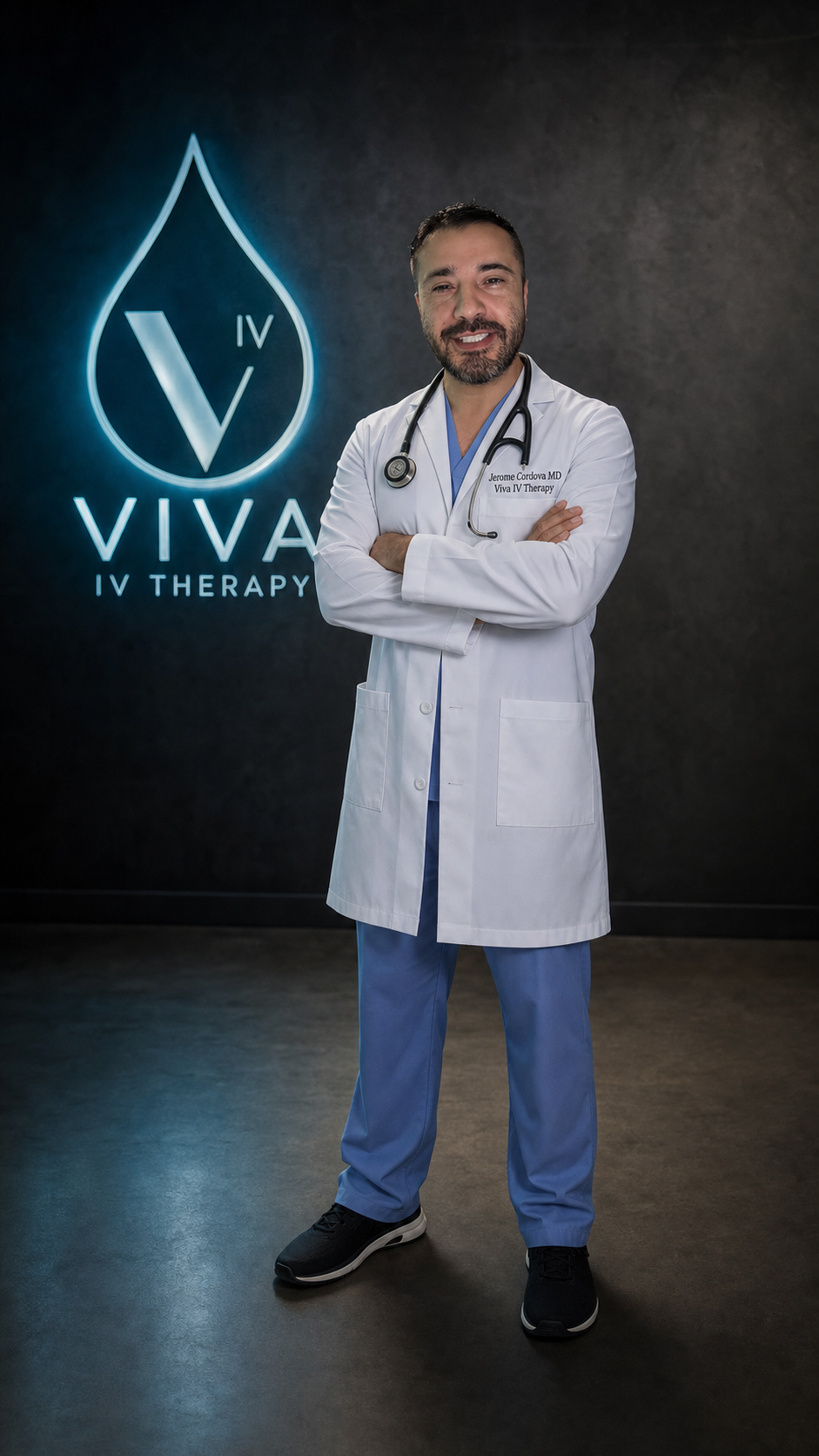
Dr. Cordova designed Viva's athletic protocols around the specific physiology of high-intensity training in Scottsdale's climate — heat adaptation, hydration demands, and the Scottsdale athletic population's specific needs.

By the Numbers

2–3%
Dehydration level at which strength output drops 5–8% and endurance capacity drops 20–30%
1–3L
Sweat loss per hour during intense exercise in Scottsdale's summer heat — far exceeding safe oral replacement rates
100%
IV bioavailability vs. 20–30% for oral nutrients limited by gastric emptying and absorption rates
45 min
Average recovery session length — in and out, back to training sooner

What We Use to Accelerate Your Recovery

All treatments are standard non-member pricing. Physician-directed by Dr. Cordova, administered by licensed RNs.

Anti-Inflammatory
Toradol Add-On
$30

IV ketorolac (Toradol) — a powerful NSAID delivered intravenously for rapid pain and inflammation management. Significantly more effective than oral ibuprofen when muscle inflammation is severe and you're dehydrated. Add to any recovery IV.

  • IV NSAID — faster, more potent than oral
  • Targets exercise-induced inflammation directly
  • Reduces recovery pain window by hours
  • Add to any athletic recovery IV
View Add-Ons →
Oxidative Stress Defense
Glutathione Push
$35 – $65

High-dose IV glutathione to neutralize exercise-induced free radicals and reduce post-exercise oxidative stress. Restores the antioxidant capacity that intense training depletes, reducing muscle fiber damage and compressing the inflammatory recovery window.

  • Neutralizes exercise-induced free radicals
  • Reduces post-exercise muscle damage
  • Supports faster inflammatory resolution
  • Ideal paired with any recovery IV
View Add-Ons →
Cellular Energy Restoration
NAD+ IV Therapy
From $200

For athletes focused on long-term performance optimization. NAD+ supports mitochondrial energy production, cellular repair, and the adaptation processes that intense training drives. Especially valuable for endurance athletes and those noticing age-related performance declines.

  • Supports mitochondrial ATP production
  • Enhances cellular repair & adaptation
  • 250mg ($200) to 1000mg ($700)
  • Ideal for monthly performance maintenance
View NAD+ →
Performance Program
TRT Program
From $199/mo

For male athletes experiencing declining performance, muscle mass, or recovery capacity with age — physician-directed testosterone optimization addresses the hormonal foundation of athletic performance. Bloodwork, diagnosis, and a physician-managed monthly protocol.

  • Hormone panel bloodwork included
  • Supports muscle protein synthesis
  • Wellness ($199) · Optimize ($349) · Elite ($599)
  • Performance gains typically begin at 4–6 weeks
Learn About TRT →

The Athlete's Recovery Session

Step 1
Walk In Post-Workout
Walk in directly after training or competition — no appointment needed. We see athletes post-run, post-race, post-game, and post-competition. The earlier post-exercise you arrive, the more effective the recovery window. Within 2 hours of your workout is ideal.
Step 2
Quick Assessment
Tell us about your workout — duration, intensity, heat exposure, muscle groups targeted. We'll recommend your IV protocol and any add-ons based on your specific recovery needs that day. Takes about 2 minutes.
Step 3
Recovery Session
Sit back while your IV runs — most athletic recovery sessions are 30–45 minutes. You can use this time to rest, stretch, ice if needed, or just decompress. Many athletes use recovery sessions as a structured rest period in their training week.
Step 4
Back in the Game
Most athletes report leaving feeling significantly better than they arrived. DOMS is reduced. Energy is restored. For competition recovery, most patients feel prepared to train again within 24 hours of a Viva recovery session — versus the 48–72 hours they needed before.
Dr. Jerome Cordova MD
Medical Director & Founder
Dr. Jerome Cordova, MD
Critical Care Physician · Biomedical Engineer · Founded Viva IV Therapy 2017 · Old Town Scottsdale

"Athletic recovery is a resource problem. Your body knows how to repair — it just needs the right inputs delivered at the right time. In Scottsdale's heat, athletes lose electrolytes and fluids at a rate that oral hydration genuinely can't keep up with. IV recovery isn't about doing something exotic — it's about giving your body what it needs, faster than any other method can."

Athletic Recovery FAQ

The post-exercise recovery window — the period when muscle repair processes are most active and nutrient uptake is highest — is approximately 2–4 hours after training. Getting your IV within this window produces the best results. That said, IV recovery is effective even hours or days after intense training if soreness and fatigue are still present.
It depends on your training volume and intensity. For high-frequency athletes (training 5–7 days per week), a weekly recovery IV session is common and highly effective. For competition-focused athletes, treatments before and after major events are the priority. Many athletes on our membership plan get bi-weekly or monthly sessions as a maintenance baseline.
All Viva IV therapy treatments use nutrients that are legal under WADA, USADA, and most sports organization drug testing protocols. We use standard pharmaceutical-grade vitamins, minerals, amino acids, and electrolytes — not performance-enhancing substances. If you have specific concerns about a particular component, discuss it with Dr. Cordova and your governing body's rules before treatment.
Absolutely. Pre-competition IV therapy — particularly our Performance IV or Ultimate IV — ensures you're fully hydrated and nutrient-loaded heading into an event. This is especially valuable for endurance athletes, triathletes, and anyone competing in hot conditions. Pre-competition sessions are ideally done 12–24 hours before your event, not immediately before.
Significantly. Sports drinks replace some sodium and sugar — they don't address magnesium, amino acids, B vitamins, glutathione, or NAD+. Protein shakes digest slowly — the amino acids reach muscle tissue 1–2 hours later, after the optimal post-exercise window has partially closed. IV therapy delivers everything directly to your bloodstream at 100% bioavailability within minutes — there is no oral equivalent for this speed and completeness.

Also Explore

Ready to Recover Faster?

Walk-ins welcome daily 10AM–7PM. Bring your training schedule — we'll build a recovery protocol around it.

(480) 508-8482

Open Daily · 10:00 AM – 7:00 PM · 7320 E. 6th Ave, Old Town Scottsdale